How many reps before adding weight? Three simple rules
Add weight when you can finish every working set at the top of your rep range with good form. If your range is 8 to 12 reps, that means 12 reps on all of your sets, not just the first one. A second common rule asks for less: add weight when you can beat your target by one or two reps on two sessions in a row. The number of sets does not decide it. What decides it is whether the sets you planned were completed with room to spare.
Both rules are old. The American College of Sports Medicine’s 2009 position stand on progression in resistance training says that when you train at a given load, a 2 to 10% increase should be applied once you can perform the current workload for one to two repetitions over the desired number, on two consecutive training sessions. It grades that recommendation B, one step below its top grade, A. The rest of this post turns it into something you can use on your next session.
Rule 1: the top of the range, on every set
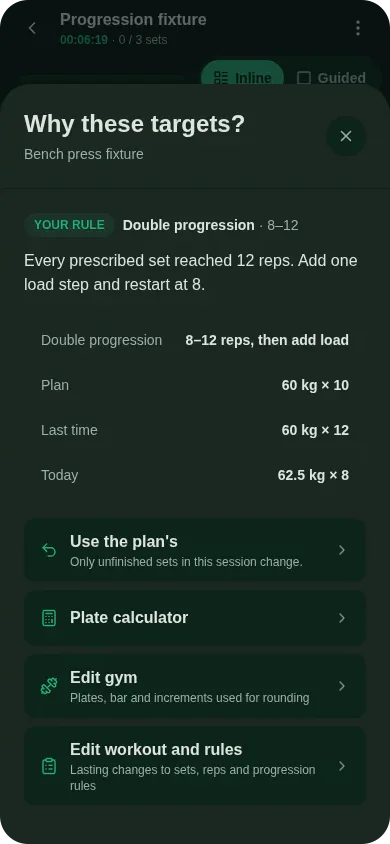
Choose a rep range for each exercise, such as 8 to 12. Work at one load and add reps over the weeks. When every working set reaches the top of the range, add the smallest load you can set and go back to the bottom of the range.
This is double progression. Use it when you want a rule you can run from a notebook, and when you do not want to rate effort. Its weakness is speed: a lift that climbs one rep a week takes a month to go from 8 to 12.
Rule 2: the 2-for-2 rule
Pick a target number of reps, say 10. When you can do 12 or more on the last set, in two sessions in a row, add weight. That is where the “2 for 2” name comes from: two extra reps, two sessions.
The ACSM wording is “one to two repetitions over the desired number on two consecutive training sessions”, so the two-sessions part matters. One good day can be a good night’s sleep. Two in a row is more likely a real change. It also means you do not need to reach a fixed ceiling: you can use it with a single target such as 5 reps or 10 reps.
Rule 3: judge it by effort
Reps in reserve (RIR) is how many more good reps you could have done when you stopped. If you plan to finish your sets with about two reps in reserve and you finish with three or four, the weight has become lighter than you planned for, so add some. If you do not rate effort yet, the RPE and RIR explainer shows how.
Effort matters here for a reason. In a 2024 meta-regression of studies on proximity to failure, muscle growth increased as sets were stopped closer to failure, while strength gains were similar across a wide range of reps in reserve. The authors call the analysis exploratory and note that the reps in reserve had to be estimated from each study’s description, so treat it as a direction, not a prescription. For you, it means that if the goal is size, easy sets where you stopped far from failure are not a good moment to stay put, and if the goal is strength, you do not need to grind every set to add load.
How much weight to add
The ACSM range is 2 to 10%, with the lower end for small-muscle exercises and the higher end for large-muscle ones. The arithmetic shows why plates matter:
| You lift | Smallest jump | As a share of the load |
|---|---|---|
| 100 kg squat | 2.5 kg | 2.5% |
| 60 kg bench press | 2.5 kg | about 4% |
| 20 kg dumbbell curl | 2.5 kg | 12.5% |
These are examples of the arithmetic, not data. They show that a 2.5 kg step is gentle on a squat and large on a curl. When the smallest step you have is above 10% of the load, add reps first and wait until you reach the top of your range. Your gym’s plate set decides the real step, and the plate calculator shows what you can actually load.
Does the number of reps matter?
Less than people think, if the sets are hard. A 2017 meta-analysis of 21 studies compared lighter loads (60% of one-rep max or less) with heavier ones, with all sets taken to failure. Muscle growth was similar between the two, and strength gains on a one-rep max test were greater with heavy loads. A 2021 systematic review concluded that counting sets near failure works as a measure of training volume when reps are between 6 and 20 or more, with other variables kept constant.
So for muscle growth, a range of 6 to 12 and a range of 12 to 20 can both work. For strength, keep some of your work in the heavier ranges. Pick the range that matches the exercise: a lower range for a squat or a press, a higher one for a leg press, a curl or a lateral raise.
When not to add weight yet
| Situation | What to do |
|---|---|
| Some sets reached the top of the range, others did not | Keep the load and add reps on the weak sets |
| Reps were reached, but form broke down | Keep the load until the reps are clean |
| You missed reps once | Keep the load. One bad session is not a trend |
| You missed reps twice in a row at the same load | Repeat it or take a lighter load, then build again |
| Every lift has stalled and you feel run down | Read about deload weeks |
If an exercise hurts, stop and check with a doctor or physiotherapist. No progression rule is a reason to push through pain.
How Musclog handles it
Musclog applies these ideas per exercise. Each exercise can use a rule you pick, such as double progression with its rep range, or the automatic default. The automatic default judges the session by its weakest working set and climbs reps first, then adds load. It also tells you why it chose a number.
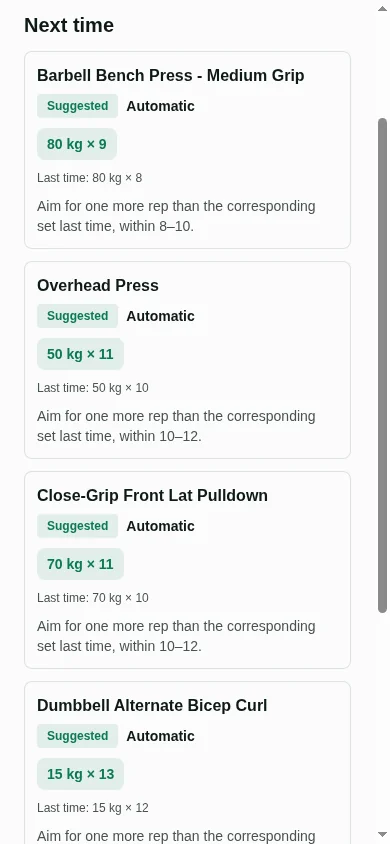
If you want a number without opening the app, the progressive overload calculator takes last session’s sets and gives the next target using the same rule.
What to do this week
- Choose a rep range for each main lift and write it down.
- Log every working set with weight, reps and, if you can, reps in reserve.
- Add load when every set hits the top of the range, or when you beat the target by one or two reps twice in a row.
- Use the smallest step you can set. When it is large, add reps first.
If you want to log and progress this way on your phone, you can get Musclog.
