How many sets per muscle per week? A table by goal
For muscle growth, most of the research points to about 10 to 20 hard sets per muscle per week. More weekly sets have tended to go with more growth, but each extra set adds less than the one before, and the studies cannot tell you one exact number. You can grow on fewer sets, so if you are new or short on time, start lower and add sets only when your progress slows. Below is a table by goal, what each number rests on, and what to do about chest, biceps and the muscles that get worked indirectly.
A table by goal
| Goal | Hard sets per muscle per week | What it rests on |
|---|---|---|
| Just starting, or short on time | About 5 to 9 | A 2019 trial in 49 trained men found 9 weekly sets of biceps training in one session enough to increase muscle thickness over 6 weeks. A 2017 meta-analysis that grouped studies as under 5, 5 to 9 and 10 or more weekly sets found only a trend across the three groups (P = 0.074). |
| Steady muscle growth | About 10 to 20 | A 2022 systematic review of studies in young, trained men suggested 12 to 20 weekly sets per muscle group as an optimum standard recommendation. The 2017 meta-analysis also found growth rising with weekly sets, though a linear dose-response had been proposed only up to about 10 to 12 weekly sets. |
| Bringing up one lagging muscle | 20 or more, with care | The same 2022 review found no difference between moderate (12 to 20) and high (over 20) volumes for the quadriceps and biceps, and a benefit of high volume for the triceps. That is a small set of studies. |
| Strength first, size second | Fewer than for size | A meta-regression of 67 studies in Sports Medicine found diminishing returns for both, and much sharper ones for strength. In an 8-week trial, 1, 3 and 5 sets per exercise gave similar strength gains in resistance-trained men, while muscle size rose with more sets. |
The ranges come from studies on mostly young men who already trained. Women, older lifters and complete beginners are less represented, so treat the numbers as a starting point and watch your own log.
What “a set” means here
The numbers count hard sets: working sets taken close to failure. A systematic review of 14 trials concluded that counting sets to failure or near it works as a measure of volume when the reps are between 6 and 20 or more and everything else stays the same. A 2024 meta-regression found that muscle growth improved as sets ended closer to failure, with caveats: the effort had to be estimated from each study’s description, and the authors call the analysis exploratory. If you want to rate how close you are, see the RPE and RIR explainer.
Warm-up sets do not count. They are light on purpose.
Sets that also work other muscles
A bench press works the chest, but it also works the front of the shoulder and the triceps. Counting every set towards every muscle overstates the work, and counting only the main muscle understates it. That Sports Medicine meta-regression sorted sets into direct and indirect ones, tried counting an indirect set as one, as a half or as zero, and found that the half-set method had the strongest evidence behind it.
You can use the same idea by hand: count a set fully for the muscle it mainly trains, and as half a set for the muscles that help.
Chest, biceps, and other muscles
People ask for a number per muscle, such as chest or biceps. I did not find a study that sets a chest-specific number, so I will not make one up. What the studies do show:
- Biceps. 9 weekly sets were enough to grow in the 2019 trial. Effect sizes were moderate to large for 18 and 27 sets compared with 9, but the differences between groups were not statistically significant. Over 20 sets showed no clear benefit over 12 to 20 in the 2022 review.
- Triceps. The same review found a benefit of high volume. Pressing already gives the triceps indirect work, which is a reason to count it in halves.
- Quadriceps. No difference between moderate and high volume in the 2022 review.
- Chest and others. No specific finding. Use the general range and let your progress decide.
Spreading sets across the week
Twice a week per muscle is a common way to spread the work. A 2016 meta-analysis of ten studies found that training a muscle twice a week beat once a week when volume was equal. The Sports Medicine meta-regression, which pooled 67 studies, found that the effect of frequency on muscle growth was compatible with negligible effects, while strength did benefit from more frequency. So the evidence is mixed: spread your sets for comfort and recovery, and do not expect frequency to do what total sets do.
How Musclog counts
The Progress screen has a Weekly sets per muscle card. Each muscle is a bar against a 10 to 20 range, and a set counts as one for a muscle it mainly trains and as a half for a secondary muscle, so you will see totals like 5.5. It counts the sets you did, warm-ups excluded, over the last 7 days, and it adds your push and pull totals and your quad and hamstring totals. Within one session a muscle’s count stops at 10, a product choice based on the idea that sets past about 10 in one session add little. The 10 to 20 range is shown as context, not a target, and the card says so.
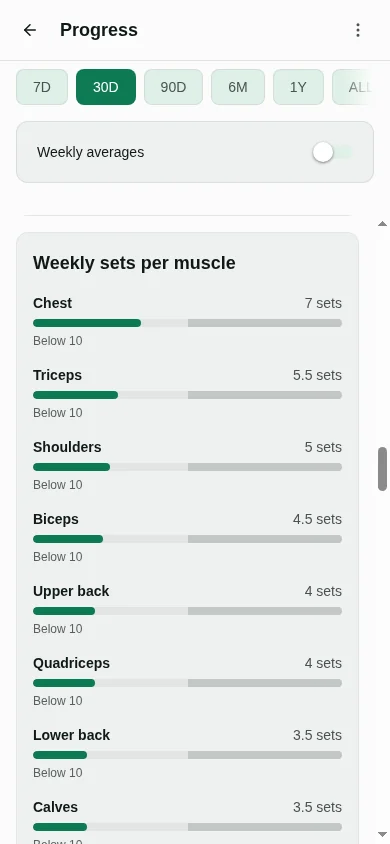
The card shows what you trained, not whether a muscle is ready for more. A bar below 10 is not a mistake. If it is the muscle you care about and progress has stalled, add one or two sets there.
What to do this week
- Count your hard sets for the one or two muscles you care about most.
- If you are under about 10 and not progressing, add one or two sets per muscle, not ten.
- If you are at 20 and stalling, check sleep, food and effort before adding more.
- Keep the changes for three or four weeks before judging them.
If a movement hurts, stop and check with a doctor or physiotherapist.
You can find a complete program in the programs list, such as the Push Pull Legs program, and Musclog keeps the count for you.
