How much rest between sets? Muscle, strength, endurance
Rest 3 to 5 minutes between heavy sets if strength is the goal, about 2 minutes (anywhere from 1 to 3) between sets of 6 to 12 reps if you want muscle, and under 90 seconds for light, high-rep endurance work. The reason is reps: the longer you rest, the more reps you keep on the next set. For muscle growth the studies find a small benefit from resting more than a minute and no clear extra benefit past about 90 seconds, so you do not need to sit through five minutes on every set. Below is a table by goal, what each range rests on, and what “rest between reps” means.
Rest between sets by goal
| Goal | Rest between sets | What it rests on |
|---|---|---|
| Maximal strength (heavy sets of 1 to 6) | 3 to 5 minutes | The American College of Sports Medicine’s 2009 position stand recommends 3 to 5 minutes for heavy loading in intermediate and advanced lifters. A 2018 systematic review says trained lifters need more than 2 minutes. |
| Muscle size (mostly 6 to 12 reps) | 1 to 3 minutes, 2 as a safe middle | The same position stand says 1 to 2 minutes. A 2016 trial found 3 minutes beat 1 minute. A 2024 meta-analysis found little difference beyond 90 seconds. |
| Muscular endurance (light loads, 15+ reps) | Under 90 seconds | The 2009 position stand recommends 40 to 60% of your one-rep max for more than 15 reps with rests under 90 seconds. |
| Beginners, for strength | 1 to 2 minutes is enough | The 2018 review found that for untrained people 60 to 120 seconds was enough to maximize strength gains. |
The middle column is my reading of studies that agree on the direction and disagree on the details. Most of the people in the studies I cite were men, many of them young, so treat the ranges as a starting point and watch your own log.
Why rest between sets matters
The practical effect of resting less is fewer reps on the sets that follow. In a 2005 study, 15 men did 4 sets of squats and bench presses with a load they could lift 8 times, resting 1, 2 or 5 minutes between sets. The 5-minute rest gave the most total reps, then 2 minutes, then 1 minute, for both lifts. The authors suggested that being able to do more volume with a given load may stimulate greater strength gains. That is an explanation they offer, not something that study tested.
An older explanation for short rests is hormonal: rests under a minute can raise growth hormone for a short time after a workout. A 2014 review looked at it and called the link between that short-lived hormone change and long-term muscle growth “highly contentious” and apparently weak. It found that of the studies measuring long-term muscle growth in groups that used different rests, none found more growth with the shorter rest and one found the opposite. Its conclusion was that the research does not support the idea that training for muscle needs shorter rests than training for strength.
How much rest between sets for hypertrophy?
Two pieces of evidence matter most.
The 2016 trial took 21 young, resistance-trained men and gave them the same program for 8 weeks: 3 total-body workouts a week, 3 sets of 8 to 12 reps on 7 exercises. One group rested 1 minute between sets and the other 3 minutes. The 3-minute group gained more strength on the squat and the bench press, and more muscle thickness in the front of the thigh, with a trend (p = 0.06) towards more in the triceps. Upper-body muscular endurance improved in both groups, with no difference between them. It is a small trial on young men, and it measured muscle thickness with ultrasound.
The 2024 systematic review pooled 9 trials and 19 measurements of muscle size in healthy adults who trained at least twice a week for at least 4 weeks. Six of the nine studies used untrained people and three used trained people, and there was too little data to analyze the trained group alone. The authors found a small benefit to resting more than 60 seconds, which they suggest may come from the volume you lose when you rest less, and they did not detect appreciable differences when resting more than 90 seconds. In their short-versus-longer comparisons the estimates for arm and thigh muscles leaned slightly towards longer rest, but the range of plausible values included zero.
So the evidence points to this: rest at least a minute or so, 90 seconds to 2 minutes is enough for most muscle-building work, and 3 minutes on heavy compound lifts does no harm if you have the time. The studies did not split results by exercise type, so I will not claim that curls need less than squats. A fair rule is the one in the next section: rest until you can repeat your target reps.
How much rest between sets for strength?
For strength the evidence is clearer and asks for more. The 2018 systematic review of 23 studies (491 participants, 413 of them male) concluded that robust strength gains are possible even with rests under 60 seconds, but that trained lifters need rests longer than 2 minutes to maximize strength gains. For untrained people, 60 to 120 seconds was enough. The 2009 position stand goes further for the heaviest work and recommends 3 to 5 minutes between sets of 1 to 6 reps for intermediate and advanced lifters.
If you are short on time and strength is the goal, short rests still build strength. They just leave some of it on the table. If you are chasing a heavy set of 3, take the long end.
Rest between sets for endurance
For local muscular endurance, the 2009 position stand recommends light to moderate loads (40 to 60% of your one-rep max) for more than 15 reps with rests under 90 seconds. Shorter rests make the work harder on purpose, so expect the reps to fall from set to set. In the 2016 trial above, though, upper-body endurance (bench press at 50% of the one-rep max, to failure) improved in both the 1-minute and the 3-minute group, with no significant difference between them, so resting longer did not cost endurance there.
Rest between reps vs rest between sets
In an ordinary set there is no rest between reps. You rest between sets, and that is what almost every study above measured. People who ask about rest between reps usually mean something else: a short pause inside a set.
Splitting a set into small clusters with a short pause between them is called a cluster set. A 2021 meta-analysis of 29 studies compared cluster sets with traditional sets and found no differences in strength, power, velocity, muscle size or endurance. Its authors note that cluster sets may produce the same adaptations with less fatigue during the session. If your reps fall off hard in the second half of a set, you do not need this technique to progress. Resting between sets works.
How to use these numbers
These are rules of thumb built on the studies, not study results themselves.
- Start the clock when you put the bar down. Setting up, changing plates and adjusting a machine happen inside the rest, so a 3-minute rest leaves less sitting time than it sounds.
- Rest until you can repeat your target reps. If the first set felt easy, start the next one sooner. If you are still breathing hard, wait.
- Put the long rests on the heavy lifts. The heaviest compound sets need the long end of the range, and lighter work can use the short end.
- Keep rests roughly the same from week to week. If you add weight with a rule like double progression, a shorter rest this week makes the comparison with last week unfair.
- Rate the effort. How close a set ends to failure matters as much as the rest before it. The RPE and RIR explainer shows how to rate it.
If you feel faint, dizzy or have chest pain, stop and get medical advice. A rest time is never a reason to push through.
Resting in Musclog
By default Musclog starts a rest timer when you complete a set. It is pinned under the workout, and you can expand it into a large countdown with buttons to take 15 seconds off, add 15 seconds, or skip the rest.
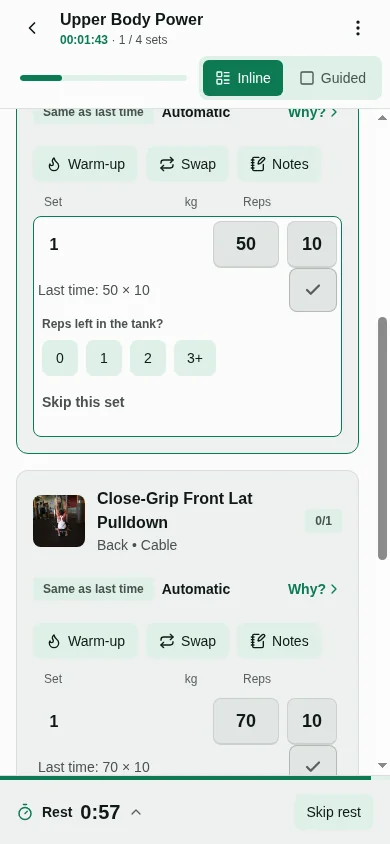
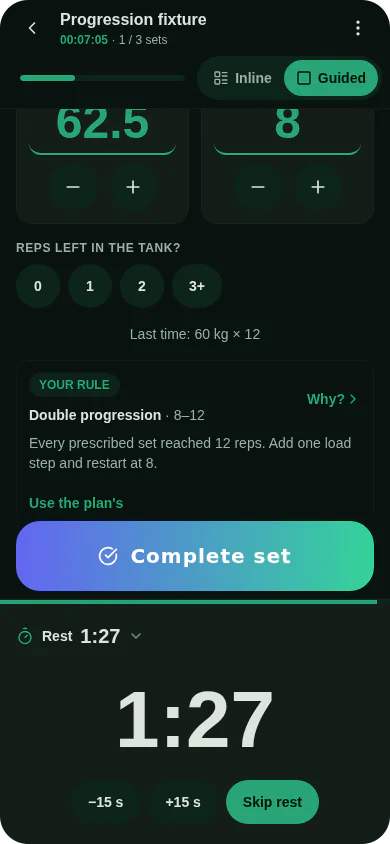
The settings are in Workout Settings → Rest timer:
- Default rest is used for sets that do not name their own rest. It starts at 90 seconds, which is a Musclog product choice that sits in the middle of the ranges above, not a study result. You can set it from 15 seconds to 10 minutes. The timer does not pick a rest by exercise type, so raise the default for a heavy day or adjust the countdown as you go.
- Start automatically begins the rest after you complete a set. Turn it off to start rests yourself with the Start rest button.
- Heads-up before rest ends turns the timer to “get ready” and buzzes once, 10, 20 or 30 seconds before the end, so you can look away from the screen and still start on time.
- Haptic countdown ticks for the last three seconds and buzzes at zero. A separate rest alert can notify you if you lock your phone.
If you track sets in Musclog, the timer and the logged reps are in the same place, so you can check whether a shorter or longer rest changed the sets that followed.
Summary
- Strength: 3 to 5 minutes on heavy sets. Trained lifters need more than 2 minutes to maximize strength.
- Muscle: about 2 minutes, anywhere from 1 to 3. Little evidence of extra benefit beyond about 90 seconds.
- Endurance: under 90 seconds with light loads and 15 or more reps.
- Rest until you can repeat your target reps, and keep rests steady so week-to-week numbers compare.
- Rest between reps is a technique, not a requirement. Resting between sets works.
