Strength standards: what a good bench, squat and deadlift is for your body weight
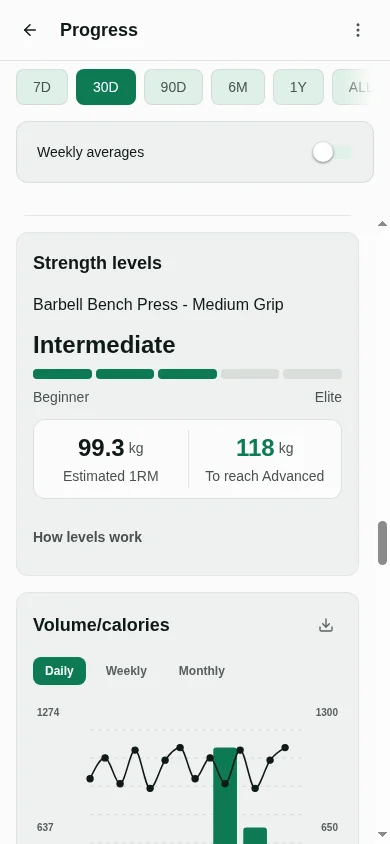
A good bench, squat or deadlift is a number that depends on your body weight, the lift, and your sex, so there is no single answer. In Musclog, a level comes from your estimated one-rep max divided by your body weight, adjusted for the lift and for sex. For an 80 kg man, the bench levels run from a 48 kg estimate for novice to 144 kg for elite. These tiers are Musclog’s own product choices, not published norms, and the rest of this post shows exactly how they are built.
How a level is worked out
The app needs one logged set of 10 reps or fewer, with your body weight. It turns that set into an estimated one-rep max, using the app’s averaged formula, and counts reps in reserve if you logged them. Sets above 10 reps give no estimate, because a long set measures endurance more than strength, and every formula drifts further from the truth the more reps it has to extrapolate. Without a body weight there is no level at all.
The estimate is then divided by a benchmark for the lift:
estimated one-rep max ÷ (body weight × the lift’s benchmark × a sex factor)
Each lift has a benchmark that is a multiple of body weight, taken from the app’s exercise catalogue: 1.4 for a barbell squat, 1.0 for a medium-grip barbell bench press, and 1.8 for a barbell deadlift. Those three are the anchors the app uses for calorie and goal estimates too, so the levels and the goal projections agree.
Five tiers sit on that ratio:
- Beginner: below 0.6
- Novice: from 0.6
- Intermediate: from 1.0
- Advanced: from 1.5
- Elite: from 1.8
These thresholds are Musclog product choices. They are not a published standard, and a level does not rank you against other people.
The numbers for 80 kg
For a man weighing 80 kg, multiply each tier by the body weight and the lift’s benchmark. The table gives the estimated one-rep max a lifter needs to reach each level.
| Level | Squat (×1.4) | Bench press (×1.0) | Deadlift (×1.8) |
|---|---|---|---|
| Novice | 67.2 kg | 48 kg | 86.4 kg |
| Intermediate | 112 kg | 80 kg | 144 kg |
| Advanced | 168 kg | 120 kg | 216 kg |
| Elite | 201.6 kg | 144 kg | 259.2 kg |
Check one row: for the squat, 0.6 × 80 × 1.4 = 67.2, and 1.8 × 80 × 1.4 = 201.6. Below 67.2 kg the squat reads as beginner. The bench and deadlift rows work the same way.
These are the men’s figures, where the sex factor is 1. For women, the app scales the benchmark down by body region: 0.75 for legs (where the squat and deadlift data sit), 0.6 for chest, shoulders and arms, and 0.7 for anything else. So a woman at 80 kg has a squat novice line of 50.4 kg (0.6 × 80 × 1.4 × 0.75).
Which lifts get a level
Only the standard versions of the main lifts are graded, so a variation does not get a level of its own. The graded lifts are:
- Barbell squat, front squat and Romanian deadlift
- Barbell deadlift and barbell hip thrust
- Barbell bench press (medium grip), barbell incline bench press
- Barbell shoulder press and standing military press
- Bent-over barbell row
- Barbell curl
- Dumbbell bench press, dumbbell shoulder press, bent-over two-dumbbell row and dumbbell curl
Dumbbell lifts are graded per hand, because both the benchmark and the weight you log are per hand. Bodyweight exercises, holds and cardio get no level.
Other, and why some lifts show a range
Sex changes the benchmark, so an answer on one scale is not always right for everyone. If you choose Other, the app shows both the men’s and the women’s scale. When the two grade you differently, it shows a range, such as “Intermediate to Advanced”, instead of picking one. That is a deliberate choice, because no single table fits.
What the level cannot tell you
A level is a rough guide to where a lift sits on Musclog’s scale. It cannot tell you how strong you are compared with other people, and it does not account for your training age, your technique, or how you recover. For example, an estimated bench of 80 kg at 80 kg of body weight reads as intermediate on the app’s scale, and that is all it says.
A single set also has limits. How many reps people can do at a given percentage of their one-rep max varies between people (Nuzzo 2024 covers this topic). The app therefore works from the set you actually did, not from a fixed percentage of one-rep max.
Try it with your numbers
Enter your body weight and one recent set on the strength level calculator. It shows your level for that lift and the one-rep max each level needs at your weight, so you can see how far the next tier is. The same grade appears in the app once you have a weigh-in and a logged set. Get Musclog on your phone to track it over time.
