How to track gym progress: a beginner's guide
You have been going to the gym for a few weeks. You feel a bit stronger, maybe. But if someone asked what you benched last Tuesday, or whether you lift more than you did a month ago, you would be guessing.
Tracking fixes that. Memory is a poor record of training, and a written one is the only way to know whether your plan is doing anything.
This guide covers what to track, what to ignore for now, how to log a workout in a couple of minutes, and how to read the numbers after a few weeks. It works with a paper notebook. I also show every step in Musclog, the free and open-source app I build, because screenshots make it concrete.
The short version
- Write down every working set: the exercise, the weight and the reps. Next session, try to beat it by a little.
- If you want, note how hard each set felt, as the number of reps you had left in the tank.
- Watch your bodyweight as a trend over weeks, not as a number that changes every morning.
- Take a photo every few weeks. It shows change the scale and the mirror miss.
- Once a week, spend five minutes on one question: did anything go up?
That is the whole system. The rest of this guide is the detail.
Why tracking works
Lifting makes you stronger because you ask your body to do a little more than it is used to, then repeat it. The American College of Sports Medicine’s position stand on resistance training names progressive overload, specificity and variation as the principles that matter most (Progression models in resistance training for healthy adults, 2009). You cannot do “a little more” without knowing what you did last time, and last time only exists if you wrote it down.
The wider evidence is about self-monitoring in general. A 2009 review of 101 studies of healthy eating and physical activity programmes found that self-monitoring explained more of the difference between programmes than any other technique the authors coded. Programmes that paired it with another self-regulation technique, such as setting a goal and reviewing it, did better than the rest. That review covers exercise and eating programmes broadly, not lifting logs in particular.
You will also see precise-sounding claims online, like “people who keep a workout log train 50% more often”. I could not trace those to a study, so I will not repeat them. The honest version is smaller: a log gives you a baseline to beat and a way to notice that you are, or are not, improving.
What should a beginner track at the gym?
| What | Why it matters | How often |
|---|---|---|
| Exercise, weight, reps | The record you beat next time | Every working set |
| Effort (reps in reserve) | Separates a hard 8 reps from an easy 8 | Optional, once logging is easy |
| Bodyweight | Shows direction over weeks | A few times a week |
| Photos | Show change the scale cannot | Every 2–4 weeks |
| Sessions per week | Consistency beats every other number | Once a week |
The first row is the whole job. Add the others one at a time, only after the previous one is a habit. Heart-rate variability, sleep scores and a dozen body measurements can wait. I would rather you log three things for a year than ten for two weeks.
The same ACSM position stand suggests 2–3 training days a week for novices, so a good week is not complicated: two or three sessions, logged.
Reps in reserve, in plain words
“Reps in reserve” (RIR) is how many more reps you could have done with good form when you stopped. Zero means you could not have done another. Two means you had two more in you.
It matters because two people can lift the same 60 kg for 8 reps at very different effort. The resistance-training RPE scale from Zourdos and colleagues (2016) ties the two together: RPE 10 is zero reps left, RPE 9 is one left, and so on. If the last set felt like you had three left, you can add weight. If you had none, you should probably not.
Your guesses will be rough at first and get better. Use broad answers: 0, 1, 2, or 3 or more.
How to log a workout with Musclog
Whatever tool you use, the loop is the same: see what you did last time, do the set, write it down, rest. Here it is in Musclog.
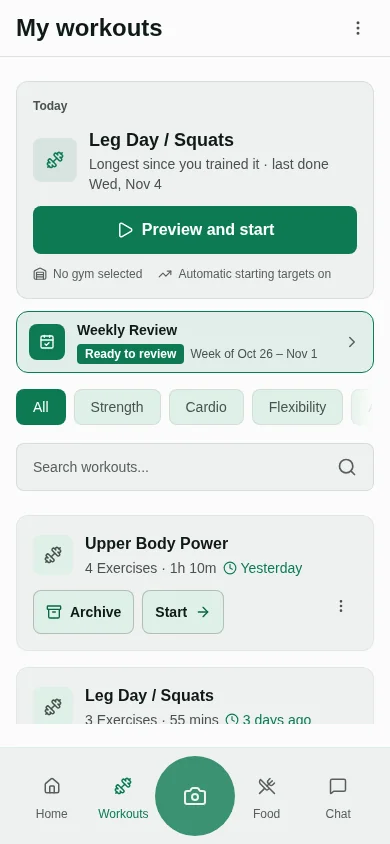
- Pick today’s workout. The Today card on the Workouts screen shows what is next: your scheduled workout, or the next one in your rotation. Tap Start, or Preview and start to look first. No plan yet? Start from a built-in program, or build your own from the exercise library.
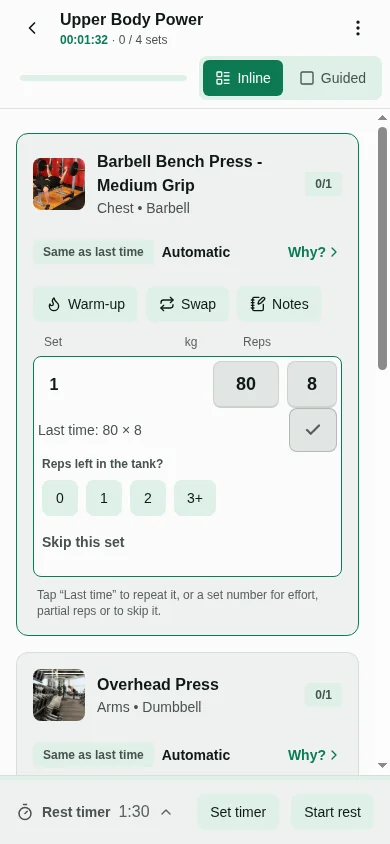
- Log weight and reps. Each exercise is a small table of sets. The fields start at the app’s target for that set, and the Last time line under the row shows exactly what you did. Type over anything that changed, then tap the tick. Tap Why? next to an exercise to see where its target came from; I wrote about that in my app now explains every number it changes. If you prefer one set at a time, switch to the Guided view at the top.
- Say how hard it was, if you like. Under each set is Reps left in the tank? with 0, 1, 2 and 3+. It is one tap, and it is what lets the app tell an easy set from a grinding one.
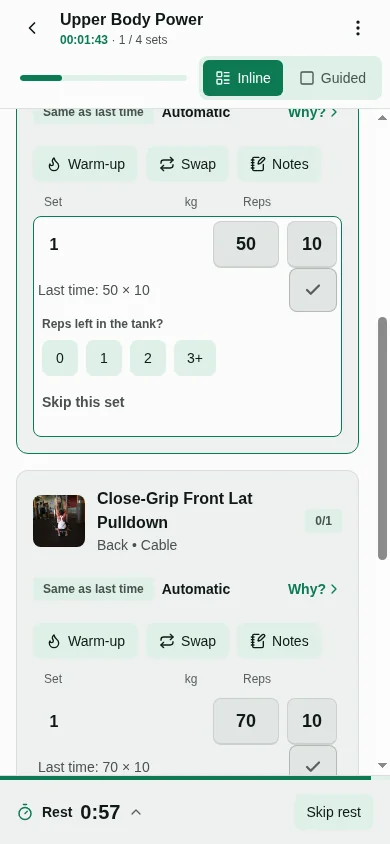
- Rest. Ticking a set starts the rest timer at the bottom of the screen. You can skip it or add time.
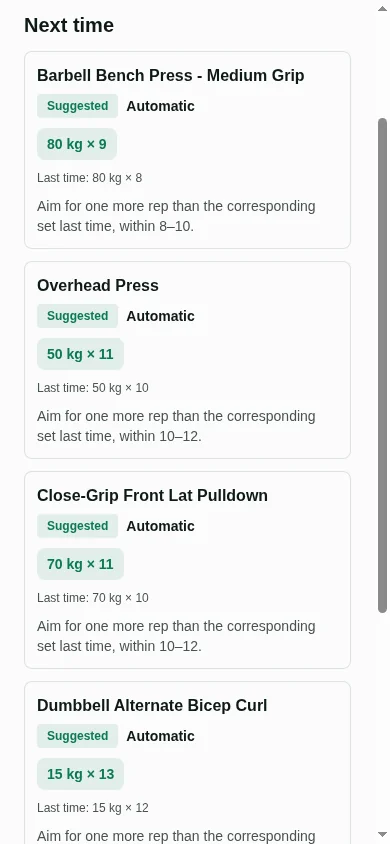
- Finish and read Next time. The summary lists a suggested target for each exercise, with the reason in a sentence: “Aim for one more rep than the corresponding set last time, within 8–10.” The targets are suggestions, and you can type over any of them.
One habit matters more than any setting: log right after each set, not at the end of the session. By then you will not remember the weights.
How to tell whether you are making progress
What counts as progress
For a beginner, any of these is progress:
- More weight for the same reps.
- More reps at the same weight.
- The same weight and reps, but it felt easier (more reps left in the tank).
- More good sets for a muscle across the week.
A heavier weight reached by cutting the range of motion short, or by bouncing the bar, is not. Count a rep only if it is the same rep you did last time.
Double progression, the beginner-friendly rule
Pick a rep range for each exercise, for example 8–10. Start at the bottom. Each session, try to add one rep. When every set reaches the top of the range, add a small amount of weight and go back to the bottom of the range.
That is the idea behind the “80 kg × 9, aim for one more rep, within 8–10” target in the screenshot above. Musclog’s methods are Automatic, Double progression, Linear, Top set with back-offs and Percentage of training max, and you pick one per exercise or leave it on Automatic.
One more thing the log protects you from: a bad day. If a lift is down one session, nothing is lost. Musclog does not lower your weight after a single poor session; it waits for two in a row at the same load. Judge by the trend, not by one workout.
Check the bigger picture on Progress
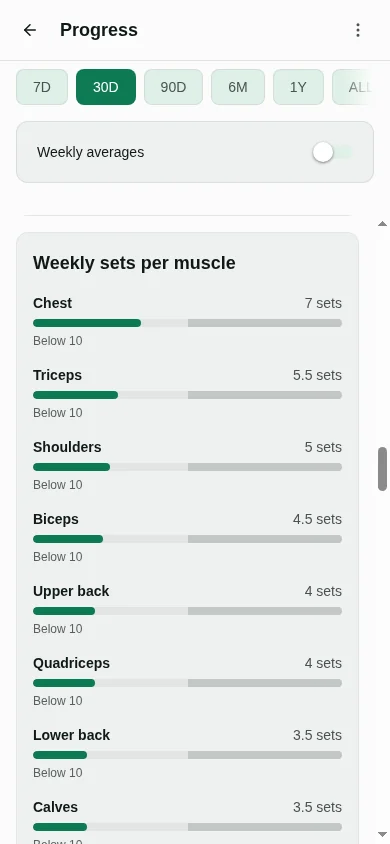
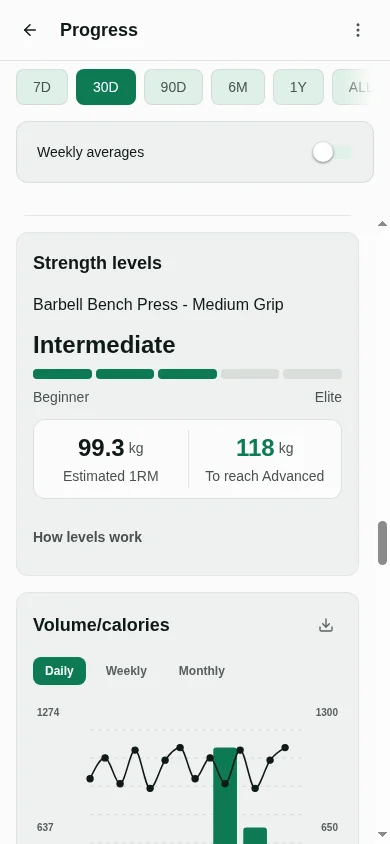
Once you have a few weeks logged, the Progress screen turns the log into charts.
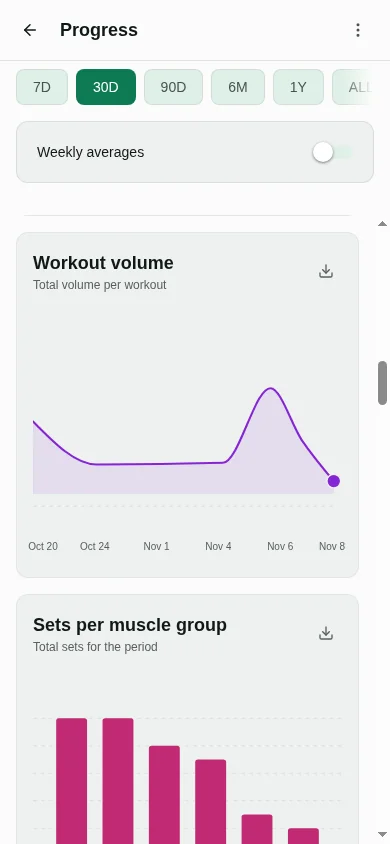
- Workout volume is the total weight you lifted in a workout (sets × reps × weight). Over weeks, a line that drifts up is a good sign.
- Weekly sets per muscle shows how much work each muscle gets. More weekly sets have tended to go with more muscle growth, at least up to about 10 sets per muscle per week, which is as far as the data in a 2017 meta-analysis of 15 studies reached. Musclog’s own note says 10–20 sets per muscle per week is a common range. As a beginner you do not need to chase that. Use the card to see where you are, then add a set where it is low.
- Strength levels turn your estimated one-rep max, a calculated guess at the heaviest single rep you could lift, into a level from Beginner to Elite for 15 main barbell and dumbbell lifts. It compares against your body weight, so it needs a weigh-in. It is a rough guide, not a verdict.
Track your body without living on the scale
Scale weight moves with water, salt, food, sleep and stress. One reading tells you very little. Weigh yourself under similar conditions, for example in the morning after the bathroom and before eating, and look at the direction over weeks. Common coaching advice is to weigh daily and average the week; others prefer two or three times a week. Pick a rhythm you will keep.
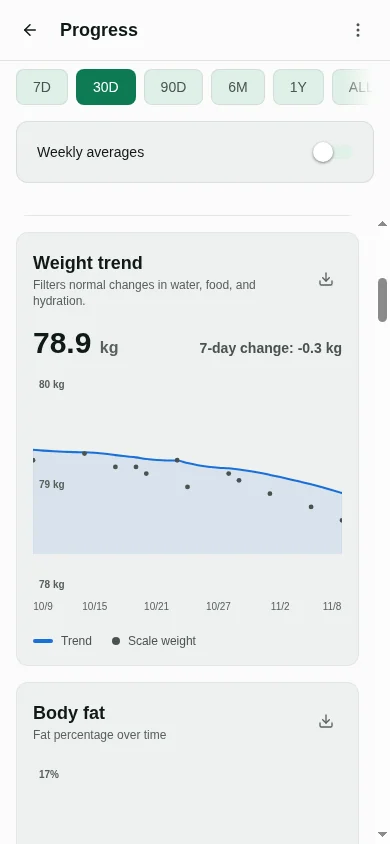
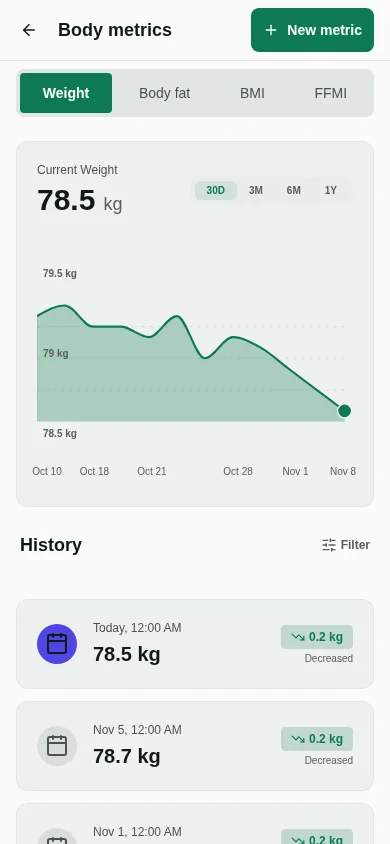
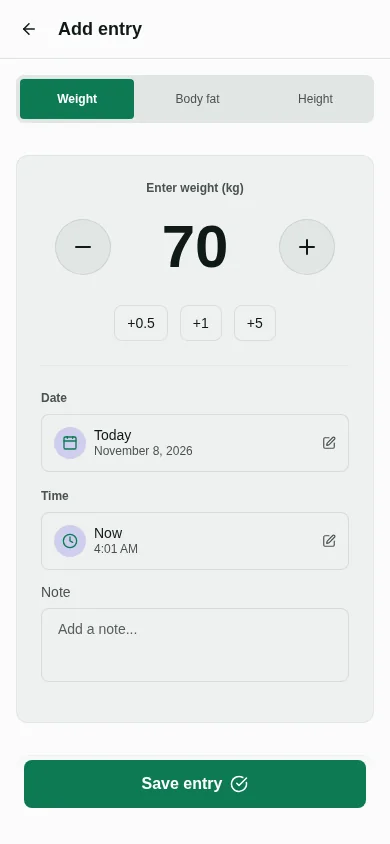
In Musclog, open Profile, tap History next to Current stats, then New metric to add a weigh-in. The Weight trend chart on Progress draws the individual weigh-ins as dots and a smoothed line through them. The app describes the line as filtering “normal changes in water, food, and hydration”. The line is the number to watch. Musclog also takes body fat percentage if you measure it. At-home methods vary a lot, so use the same one each time.
For photos and tape measurements, a phone does the job. Take photos in the same place, light and pose every 2–4 weeks and keep them in your gallery. Write waist, chest, arm and thigh measurements in a note. This is common coaching advice rather than settled science, but it is cheap and it works for most people.
Once a week, ask one question
Pick a day. Spend five minutes on this:
- Did I do the sessions I planned?
- Did at least one lift go up, in weight, reps or ease?
- What is the bodyweight trend over the last two or more weeks?
- What is one thing to change next week?
Musclog has this built in as the Weekly Review.
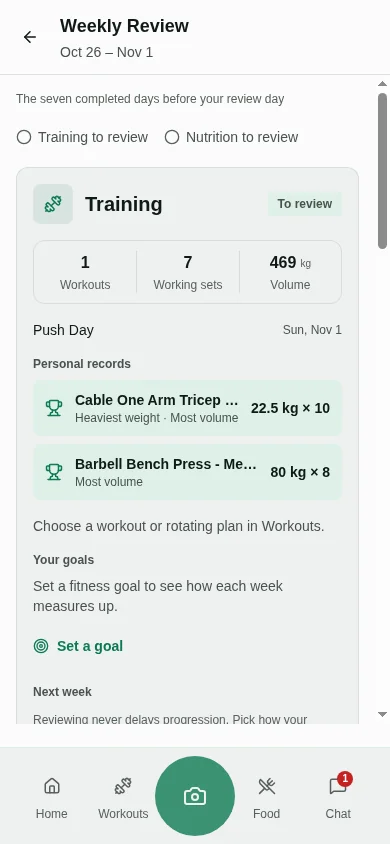
The training half shows what you did last week (workouts, working sets, volume and any personal records) and recommends keeping progressing, repeating last session or taking a lighter week, with its reasons. It changes nothing on its own. You choose, and your choice shapes how next week’s workouts start.
Mistakes that make beginners quit tracking
- Tracking too much. Ten metrics feel thorough on day one and exhausting by week three. Start with the lifts.
- Logging from memory. Write it down between sets. After the session you will round everything.
- Judging by one day. A bad session is noise. Look at two or three weeks.
- Changing exercises every week. You cannot compare what you do not repeat. Keep the same lifts for a block of weeks.
- Chasing numbers at the cost of form. An extra kilo done badly is not progress, and it is how people get hurt.
- Only watching the scale. Strength, photos and how clothes fit tell you things the scale cannot.
A four-week way to start
- Week 1: log every set of every session. Nothing else.
- Week 2: add reps in reserve to your first exercise of each session.
- Week 3: add weigh-ins, two or three a week.
- Week 4: take your first photos and do your first weekly review.
If you are coming back after a long break, ease in rather than picking up where you left off. I wrote about how Musclog helps with that in I stopped after a summer of travel, so Musclog can ease you back in.
Frequently asked questions
Do I need an app to track gym progress?
No. A notebook or a spreadsheet works, and the best tracker is the one you will actually open between sets. An app helps with the parts that are tedious on paper: it shows last time for you, runs the rest timer, suggests the next target and draws the charts.
How often should I weigh myself?
Often enough to see a trend, rarely enough to stay sane. Two or three times a week under similar conditions works for many people, and daily weighing with a weekly average works for others. Whatever you choose, read the trend, not a single day.
How long until I see progress?
It varies by person, training and food. Strength usually goes up before size does, and most beginners notice they can lift more within a few weeks. Visible changes take longer. Your log will show the first kind long before the mirror shows the second.
Can I bring my history from another app?
Yes. On Android and iOS, Musclog can import workout history from Strong, Hevy and FitNotes CSV exports (Settings, then Data). It matches exercises by name and asks you about anything unclear. Importing the same file twice adds nothing, and an import can be undone.
Is Musclog free, and what happens to my data?
Musclog is free and open source, and your training and food logs stay on your device. Nothing is sent to a server unless you turn on an optional feature such as AI.
Start tracking today
If you want to try this in Musclog, it is on the download page: Google Play for Android, and TestFlight for iOS. If you would rather use a notebook, do that. What matters is that tonight’s numbers exist when you walk in next time.
This guide is general information, not medical advice. If you have an injury or a health condition, or you are returning after a long break, check with a doctor or a qualified coach before you start.
Sources
- American College of Sports Medicine, Progression models in resistance training for healthy adults (position stand, 2009).
- Michie et al., Effective techniques in healthy eating and physical activity interventions: a meta-regression (Health Psychology, 2009).
- Zourdos et al., Novel resistance training-specific rating of perceived exertion scale measuring repetitions in reserve (Journal of Strength and Conditioning Research, 2016).
- Schoenfeld, Ogborn and Krieger, Dose-response relationship between weekly resistance training volume and increases in muscle mass (Journal of Sports Sciences, 2017).
