Body recomposition: how to eat, lift and track it
Body recomposition means gaining muscle and losing fat at the same time. It is often said to happen only in beginners and in people with a lot of fat to lose, and a 2020 review argues it also happens in trained lifters. What drives it is progressive resistance training and enough protein, with calories at maintenance or only a small deficit. No calculator can give you a recomposition number, because the maintenance figure every one of them starts from is an estimate. The reliable way is to start from that estimate and adjust from your weight trend, your waist and your lifts. This post covers what the studies say, how to set calories and protein, what changes for beginners and after 40, and how to track a change the scale hides.
Does body recomposition work?
Yes, in the studies below, with limits. There is no standard definition, and Barakat and colleagues, in the 2020 review, use the term for building muscle and losing fat at the same time. They report a substantial amount of literature showing it in resistance-trained people, name two key factors (progressive resistance training and evidence-based nutrition), and look at sleep and hormones too. They also list the limits of body composition assessment among their topics, which is one reason to read several signals instead of one number.
A trial that shows the idea in an extreme form is Longland and colleagues (2016). It was a proof-of-principle study: 40 young men ate about 40% fewer calories than they needed for 4 weeks, and trained with weights and high-intensity intervals 6 days a week. Half ate 1.2 g of protein per kilogram of body weight a day and half ate 2.4 g. Measured with a four-compartment model, the higher-protein group gained 1.2 kg of lean mass and lost 4.8 kg of fat; the lower-protein group gained 0.1 kg of lean mass and lost 3.5 kg of fat. Both groups’ improvements in exercise performance were similar.
That is not a plan to copy. It was four weeks, in young men, at a deficit and a training load that is hard to keep up. What it shows is that, in a hard deficit with hard training, the higher-protein group did better.
Calories: maintenance or a small deficit
Eating less costs you muscle gain on average. A 2022 meta-analysis and meta-regression of randomized trials of resistance training in an energy deficit lasting at least 3 weeks found that lean mass gains were smaller than in groups without a deficit (effect size -0.57, p = 0.02), while strength gains were comparable (-0.31, p = 0.28). In the meta-regression, a deficit of about 500 kcal a day was where the predicted lean mass gain disappeared. The authors’ advice was to avoid prolonged energy deficiency if you are training to build muscle, and to avoid deficits above 500 kcal a day if you are training to keep muscle while losing weight.
That is an average across studies, not a threshold for you. Read it as a direction: the closer to maintenance, the easier it is to gain muscle. So the plan that follows from it is:
- Start at your estimated maintenance calories.
- If you have fat to lose, you can eat a little below that, well under 500 kcal a day. That small deficit is my reading of the meta-regression, not a tested prescription.
- Adjust after a few weeks from your weight trend, not from the formula.
Body recomposition calculator: what it can and cannot do
A formula such as Mifflin-St Jeor estimates maintenance from your sex, age, height, weight and an activity guess. Musclog’s calculator does that, and the calorie deficit tool turns a goal weight and date into a daily target. Why every TDEE calculator is wrong explains why the figure is an average and how your own records replace it.
With invented numbers, the example man from that post (80 kg, 180 cm, 35 years) has a formula maintenance of about 2,720 kcal a day. A “recomposition” target for him is that number, or a few hundred calories under it if he has fat to lose. A calculator that promises exact calories and an exact amount of muscle gained is promising something nobody can know before you try it.
Protein for body recomposition
The 2018 meta-analysis by Morton and colleagues pooled 49 trials with 1,863 healthy adults. It found that protein supplementation added a small amount of fat-free mass during resistance training (0.30 kg on average), and that beyond a total intake of about 1.6 g per kilogram a day (1.62 in the paper) there was no further gain in fat-free mass. In a deficit, Longland’s 2.4 g per kilogram did better than 1.2 for lean mass and fat loss.
Musclog’s own defaults are 1.8 g per kilogram for building muscle and at least 2.0 in any deficit. They are product choices that sit near the Morton figure and above it in a deficit, not the result of one study. The protein post and the protein calculator show how it is worked out. For the 80 kg example, 1.6 to 2.0 g per kilogram is 128 to 160 g of protein a day.
Training for body recomposition
The training half is the usual one: lift, and add load or reps over time.
- Progressive overload. Add weight or reps when you reach the top of your range. Double progression is the simplest way to do it, and how many reps before adding weight gives the rules.
- Enough sets. Most of the research points to about 10 to 20 hard sets per muscle per week, and fewer if you are new. See how many sets per muscle per week.
- A program you can keep up. A 3-day program done for months beats a 6-day program dropped in week three. The free 3-day full body program is one way to start.
Body recomposition for beginners
Beginners are the group it is most often said to happen in: the 2020 review’s abstract notes the common view that it occurs only in untrained or novice people. If you are starting out, or coming back after a break, keep it simple:
- Train three days a week with a basic program and write down every set.
- Eat near maintenance, with protein at 1.6 g per kilogram or more.
- Judge by four-week averages of your weight trend, your waist and your lifts, not by any single day.
If you are returning after a layoff, coming back to the gym after a break covers the first weeks and what weight to start with. Do not go in with a large deficit: the meta-regression above is the reason.
Body recomposition after 40
None of the studies I cite looks at body recomposition in people in their forties, so I have no figure to give for that age. The nearest evidence is from adults aged 50 and over and from analyses where age was a variable.
- A 2011 meta-analysis of resistance training in adults aged 50 and over pooled 49 studies and 1,328 participants and found an average gain of 1.1 kg of lean mass (95% confidence interval 0.9 to 1.2). Higher-volume programs gained more, and older participants gained less.
- Morton’s meta-analysis found the effect of protein supplementation on fat-free mass got smaller with increasing age.
- The PROT-AGE position paper recommends at least 1.0 to 1.2 g of protein per kilogram a day for people over 65, 1.2 g or more for those who exercise, and 1.2 to 1.5 g for most people with acute or chronic disease. It makes an exception for severe kidney disease, where protein may need to be limited.
In practice that means expecting slower change, not cutting hard, and not skimping on training volume, since higher-volume programs gained more in the 2011 meta-analysis. If you have kidney disease or another condition, or you take medicines that affect your diet, talk to a doctor before you raise your protein intake.
How to track body recomposition
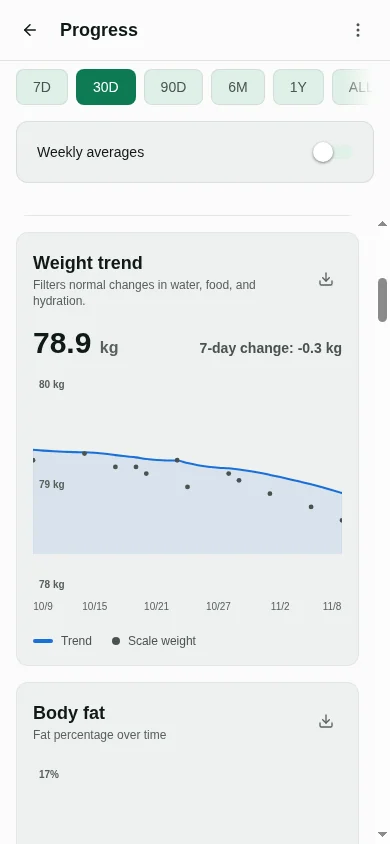
The scale alone can mislead during recomposition, because muscle gained and fat lost can offset each other on it. It is also noisy. Orsama and colleagues (2014) analyzed 4,657 weights from 80 adults and found a weekly rhythm: weight was higher early in the week, on Sundays and Mondays, and decreased through the week, with increases starting on Saturday and decreases on Tuesday. The authors say weekend-to-weekday variation should be seen as normal rather than as weight gain.
So track four things together, over at least four weeks:
| Signal | What to watch |
|---|---|
| Weight trend | A flat or slowly falling line, not single weigh-ins |
| Waist | Staying the same or shrinking |
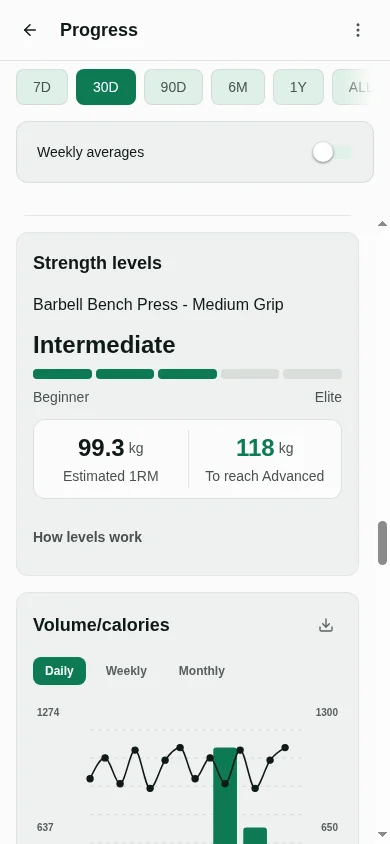
| Lifts | Weight, reps or estimated one-rep max going up |
| Photos or fit | Same light, pose and clothes every few weeks, and how your clothes fit. This is common coaching advice, not settled science |
These readings are a rule of thumb, not a study result:
| What you see over four weeks or more | What it may mean | What to try |
|---|---|---|
| Trend flat or slightly down, waist same or smaller, lifts up | It is working | Change nothing |
| Trend dropping and lifts stalling or falling | You may be eating too little | Add some calories and check your protein |
| Trend rising and waist growing | You may be gaining more fat | Trim calories a little |
| Everything flat | The training is not progressing | Check you are adding load or reps, and sleep |
Sleep and hormones sit outside training and food, and Barakat’s review looks at them too. If tracking numbers makes you anxious, or you have a history of an eating disorder, skip the calorie math and talk to a doctor or a registered dietitian first.
Try it in Musclog
In Musclog, a maintenance goal is one of the goal options, and the Weight trend chart draws your weigh-ins as dots with a smoothed line through them. Body metrics accepts waist as a metric, and the Strength levels card shows your estimated one-rep max for main lifts. Once you log food and weight, Musclog replaces the formula with an estimate from your own records, as described in the TDEE post above. That gives you a maintenance figure measured on you, which is the number a recomposition plan needs.
Summary
- Body recomposition is often described in beginners and people with fat to lose, and a 2020 review reports it in trained lifters too.
- Eat near maintenance, or a small deficit well under 500 kcal a day. Larger deficits cost muscle gains.
- Eat about 1.6 g of protein per kilogram a day or more, and more in a deficit.
- Lift with progressive overload.
- Track the weight trend, your waist and your lifts together over four weeks or more, not the scale on its own.
- With age, the studies show smaller gains, so expect slower change, and talk to a doctor if you have a medical condition.
